


Views: 0 Author: Site Editor Publish Time: 2026-11-24 Origin: Site


Between the packaging line that only needs an A2 glove and the recycling yard that genuinely requires an A6, most US industrial purchasing happens inside a five-band window. Choosing correctly inside that window is where safety directors protect hands and budgets: over-specifying wastes money and costs dexterity, while under-specifying turns a near miss into a recordable laceration. This guide maps the ANSI A2–A6 bands to the tasks US buyers actually procure for, and shows what to demand from an OEM glove supplier before the first container ships. For the full nine-band scale, start with our ANSI A1–A9 buyer's guide.
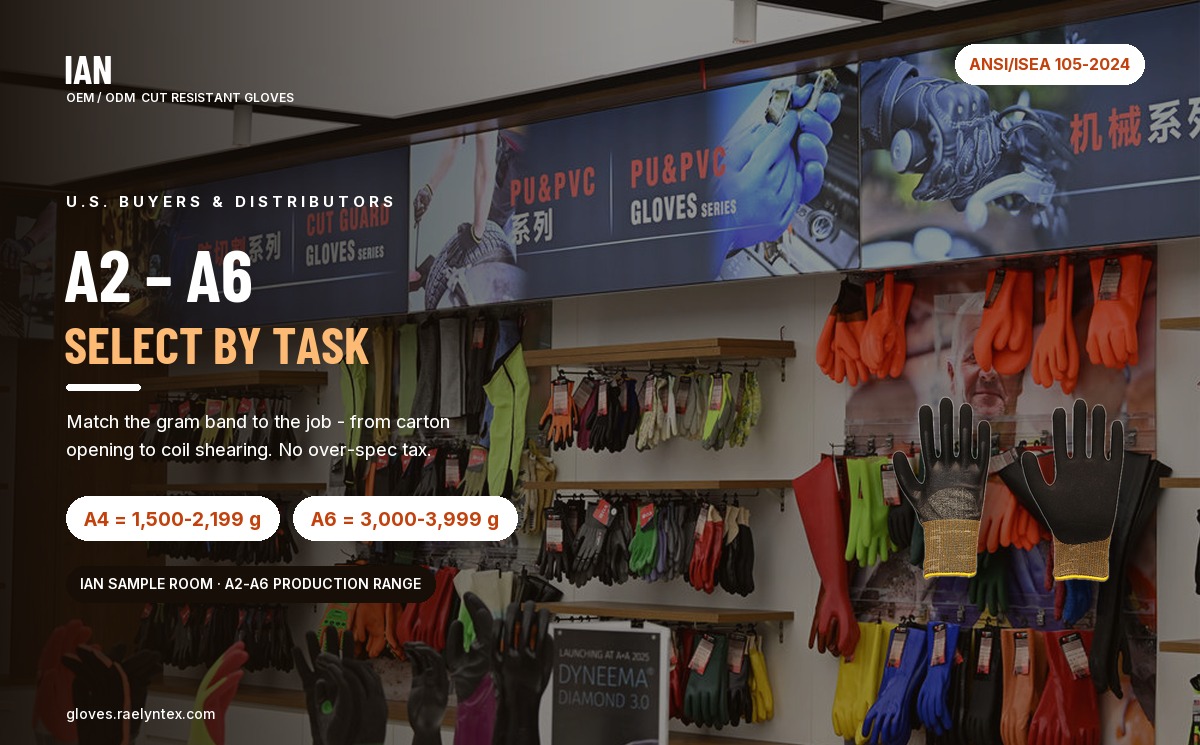
ANSI/ISEA 105 (current edition 2024) grades cut resistance in gram bands measured on the TDM-100 straight-blade machine under ASTM F2992: the number is the force needed to cut through the material. A2 through A6 covers 500 to 3,999 grams — the range where roughly 80% of general industrial cut hazards sit. European buyers will recognize the neighboring EN 388 letter scale; the two use the same test principle but are not interchangeable, which we break down in our EN 388 vs ANSI 105 conversion guide.
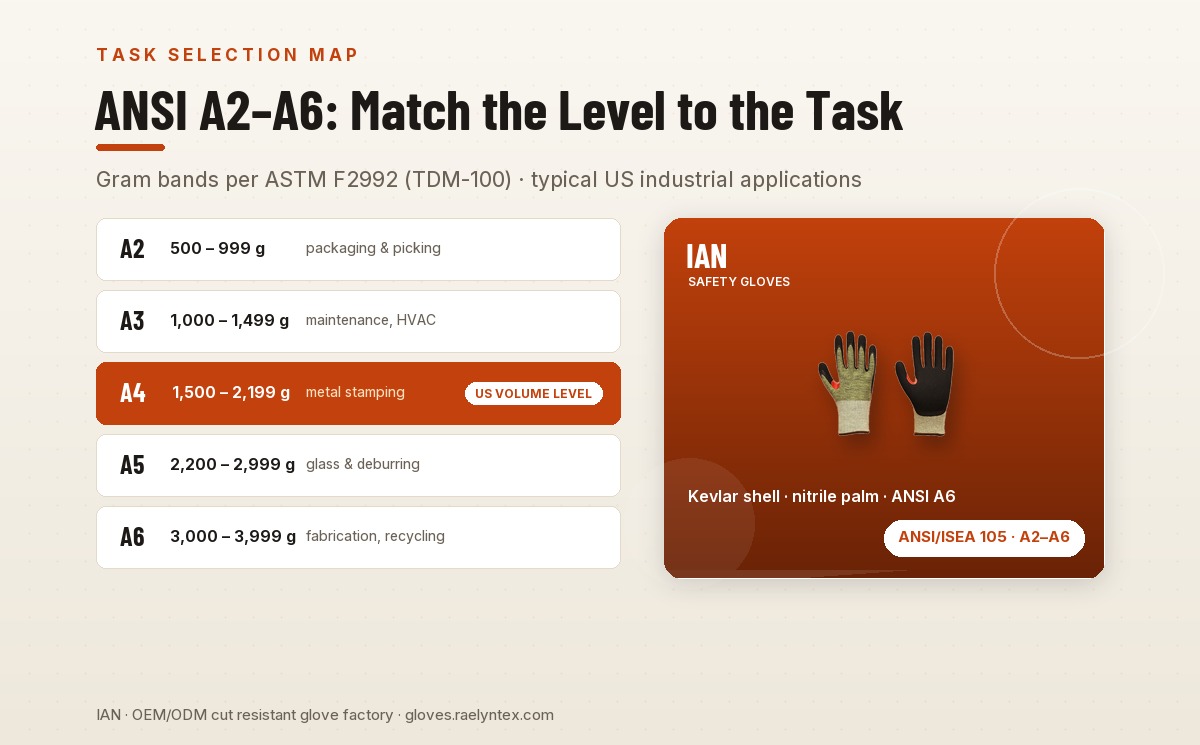
| ANSI Level | Cut Force (grams) | EN 388 (approx.) | Typical US task |
|---|---|---|---|
| A2 | 500 – 999 g | ~B | Carton opening, parts assembly, general warehouse handling |
| A3 | 1,000 – 1,499 g | ~C | Equipment maintenance, HVAC duct work, plastic molding |
| A4 | 1,500 – 2,199 g | ~D | Construction, sheet metal handling, automotive stamping |
| A5 | 2,200 – 2,999 g | ~E | Glass processing, sharp stamping and deburring |
| A6 | 3,000 – 3,999 g | ~F | Metal fabrication, recycling and scrap, blade changeovers |
A2 — warehouse and packaging. If your hazard is corrugated edges, stretch wrap, and sharp plastic trim, an A2 nitrile-coated glove delivers the protection with the thinnest build, which is exactly what pickers and assemblers need for all-day fine work. Stepping up to A4 here buys nothing except stiffer hands and higher cost per pair.
A3 — maintenance and mixed duty. Plant maintenance crews touch everything: duct edges, injection-molded parts, utility knives. An A3 dotted-palm glove is the workhorse for these mixed loads because it adds grip and abrasion life without the bulk of higher levels.
A4 — construction and metal stamping. This is the volume level of US distribution: one glove that covers job-site sheet goods, automotive stamping cells, and most fabricated-metal handling. Our A4 nitrile-coated cut resistant gloves pair an HPPE-blend shell with a sandy nitrile palm, which is why safety managers standardize on it across shifts. If you distribute into metalworking, see our dedicated metalworking and glass manufacturing guide.
A5 — glass and sharp-edge stamping. Glass sheets, blade-intensive deburring, and thin-gauge stainless push past what A4 shells handle comfortably. An A5 glove typically adds steel or basalt fiber into the knit. Expect slightly reduced dexterity — rotate A5 stock only to the stations that genuinely cut.
A6 — fabrication and recycling. Scrap metal, bandsaw changeovers, and coil shearing are the top of the normal-buying window. An A6 Kevlar-shell glove with a nitrile palm is the standard answer; beyond A6 you enter the special-hazard territory covered in the A1–A9 guide rather than everyday procurement.
Cut level measures the shell against a straight blade — nothing else. Three factors routinely decide whether a glove performs in the field: first, the coating, which governs grip on oily parts (sandy nitrile sheds oil, PU stays precise but less oily-grip); second, gauge and fit, because a loosely fitting 13-gauge A4 behaves worse than a snug one, and sizing runs must be enforced on the floor; third, abrasion and palm wear, since most "failed" gloves are replaced for worn palms long before cut performance degrades. Buyers comparing coated options should also review our nitrile-coated gloves guide for US distributors and the full nitrile coated gloves range.
OSHA's hand-protection rule (29 CFR 1910.138) requires employers to select hand PPE based on a documented hazard assessment — it does not prescribe a cut level. That means your A2–A6 decision must trace back to a written assessment, and auditors increasingly ask for that paper trail along with the gloves' test documentation. Our OSHA 1910.138 explained article walks through building that file. Note that a site handling impact risks alongside cut risks may need a TPR-backed glove, which we cover separately in ANSI/ISEA 138 impact gloves explained.
Because IAN operates as an OEM/ODM cut resistant glove factory, our US distributor and importer customers typically request four things before committing to a program:
Third-party or in-house test reports per lot — ASTM F2992 TDM-100 results for the claimed level, on the production shell, not a datasheet from a different model.
Level-appropriate construction transparency — HPPE blend for A2–A4, added glass/steel/basalt fiber for A5, Kevlar or dual-fiber for A6, so your spec survives a buyer's audit.
Low-MOQ trial orders — pilot 200–500 pairs across sizes at target sites before scaling a full container.
Private-label and custom packaging — your brand, your size curve, your spec sheet printed and carton-marked to your SKU system.
Comparing suppliers on cost per gram of protection — not cost per pair — usually settles the A2–A6 buy correctly: a slightly pricier A4 that truly tests at 1,800 g outlives a cheaper pair that drifts to 1,200 g.
Walk one shift with each crew, list every sharp contact, and let the gram bands fall out of the observations. Most US facilities end up standardizing on two levels — typically A2/A3 for light zones and A4/A5 for metal zones — instead of stocking all nine. The full cut resistant gloves lineup, including the ANSI A1–A9 classified range and the broader cut levels and materials buyer's guide, is on-site for reference; for OEM samples, test reports, or a quote, contact IAN and tell us your tasks — we'll map them to the right level.

