


Views: 0 Author: Site Editor Publish Time: 2026-11-26 Origin: Site


Canada runs one federal glove standard and ten provincial enforcement regimes, and the packaging language rules change the moment a carton crosses into Quebec. For a distributor building a nitrile coated programme, that combination — provincial OHS hand-protection duties plus bilingual labelling — decides which models you can list, what artwork goes on the bag, and which documents stay on file. This guide walks through the regulatory requirements, the CSA Z195 versus EN 388 equivalency question, the packaging rules that trip up importers, and what an OEM factory like IAN customises for a shelf-ready programme under your label.
Nitrile is the default coating in Canadian industry for the same reasons it is everywhere else: it grips oil, resists abrasion, and stays stable in cold weather where latex stiffens and swells. But the Canadian market adds its own layer on top, and the buyers who win shelf space spec against that layer from the sampling stage. If you are comparing coating families first, start with our nitrile coated gloves overview, then come back for the Canada-specific paperwork.
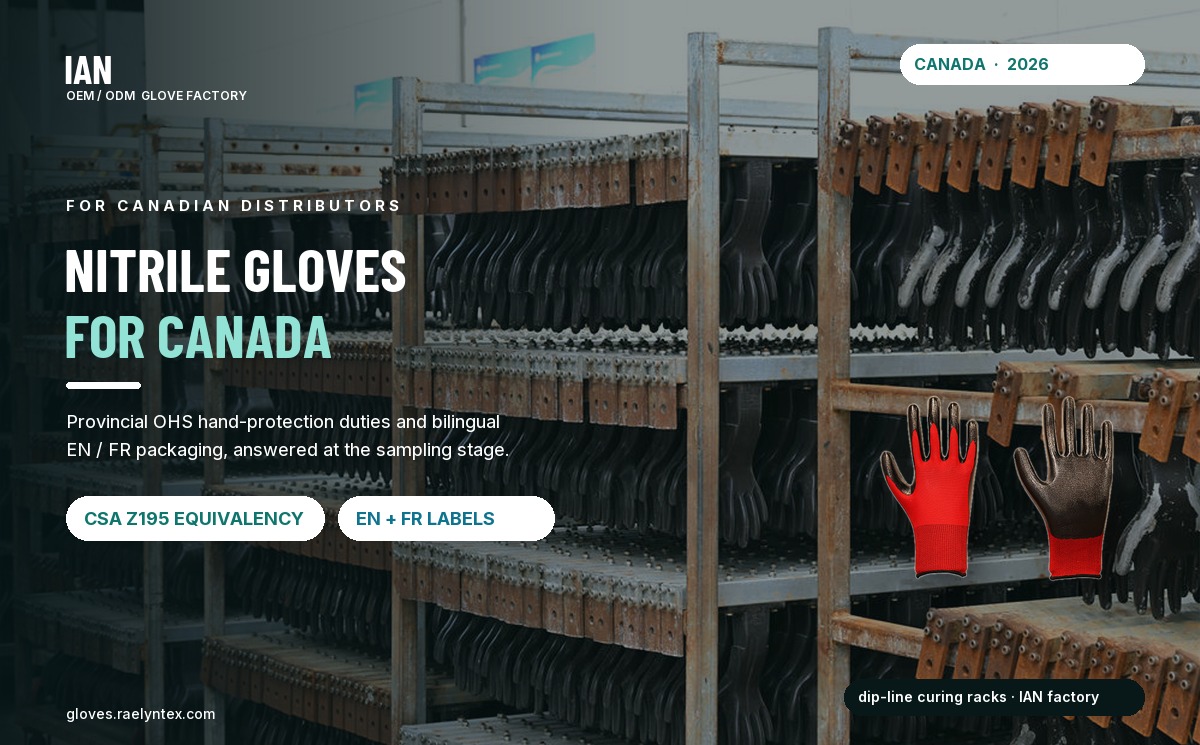
Canadian industrial demand concentrates where nitrile is already the right chemistry: oil and gas field services, machining and fabrication, mining, logistics, and winter outdoor work from forestry to utilities. A nitrile film resists petroleum oils, greases and many solvents — the hazards that swell natural rubber — and keeps its flexibility at low temperatures. For crews working a Prairie winter or a BC forestry site, that cold flexibility is a compliance point, not a comfort point: a coating that cracks at −20 ℃ stops protecting hands mid-shift.
Within the nitrile family, three finishes cover most Canadian applications. Smooth nitrile on a 13 gauge liner suits precision parts handling — see smooth nitrile palm coated work gloves. Sandy finishes raise grip on oily stamped parts and wet steel: sandy nitrile coated work gloves and the heavier abrasion resistant sandy nitrile work gloves. Foam and dotted variants handle assembly and slippery general handling, including the nitrile dotted anti-slip work gloves warehouse crews reorder constantly. The finish trade-offs are mapped in sandy vs foam vs smooth nitrile, and the coating chemistry in Nitrile vs Latex vs PU coated gloves.
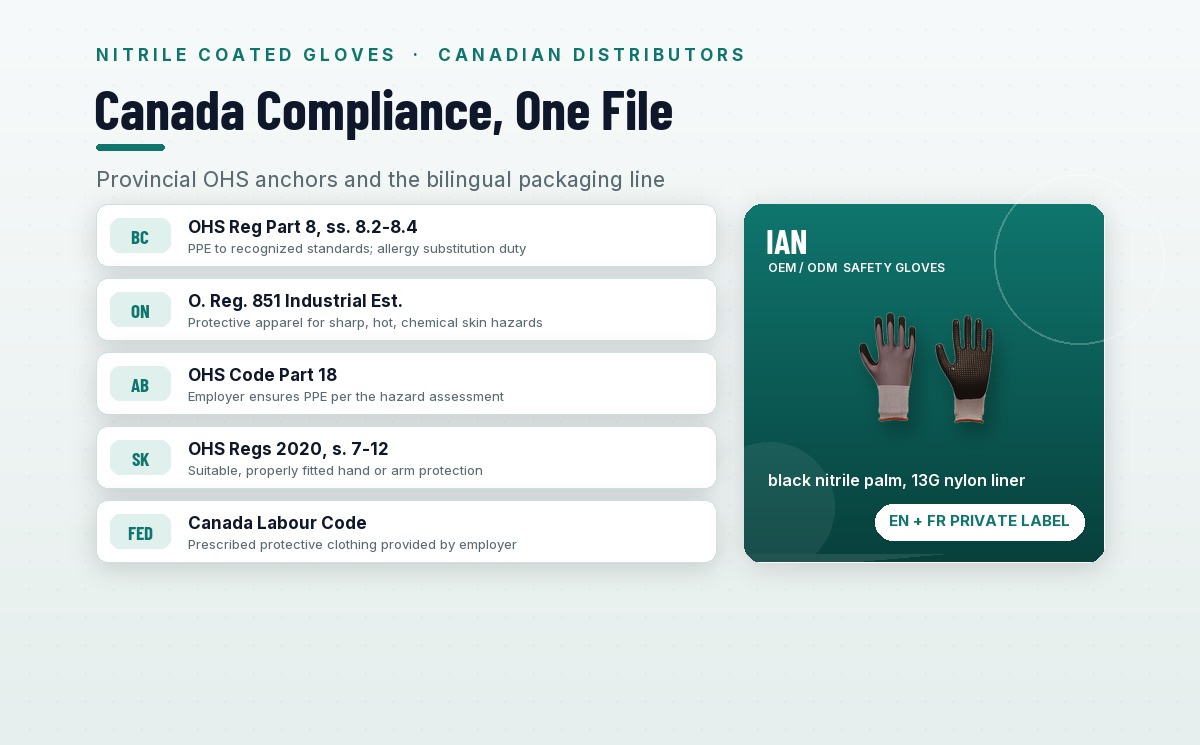
Canada has no single national OHS statute for provincial workplaces. Each province runs its own regulation, and every one puts hand-protection duties on the employer. The differences matter less than the pattern — all of them require a hazard assessment and PPE meeting a recognised standard — but a distributor quoting into multiple provinces should know the anchors:
| Jurisdiction | The anchor rule | What it means in practice |
|---|---|---|
| British Columbia | OHS Regulation Part 8 (ss. 8.2–8.4) | Workers supply their own general purpose gloves; the employer provides all other required PPE at no cost. PPE must meet recognised standards and must not itself create a hazard — if it causes an adverse reaction (for example a latex allergy), the employer must provide an alternative, a built-in argument for nitrile. |
| Ontario | OHS Act + O. Reg. 851 (Industrial Establishments) | Workers must wear protective apparel where skin may contact noxious gas, liquid, fume or dust; sharp or jagged objects; hot objects or molten metal; or radiant heat. |
| Alberta | OHS Code, Part 18 (PPE) | The employer must ensure workers wear PPE appropriate to the hazard assessment, including hand protection against abrasion, puncture and contact hazards. |
| Saskatchewan | OHS Regulations 2020, s. 7-12 | The employer must provide and require suitable, properly fitted hand or arm protection for chemical or biological contact, extreme temperatures, prolonged water exposure, and puncture or abrasion. |
| Federal worksites | Canada Labour Code + Canada OHS Regulations | Prescribed protective equipment and clothing must be provided by the employer in federally regulated industries. |
Two details in these rules are quietly commercial. First, the BC requirement that PPE "be selected in accordance with recognized standards" is what pulls CSA Z195 (or an accepted equivalent) into the conversation — a distributor who arrives with per-model test reports is answering the employer's duty for them. Second, the substitution duty — replace PPE that causes an allergic reaction — is a recurring order driver for nitrile over latex in mixed crews. Our US distributor's guide to ANSI/ISEA 105 and German buyer's guide to EN 388 and REACH cover the sibling regimes if you ship into those markets from the same programme.
CSA Z195 is the Canadian standard for protective gloves, grading mechanical performance — abrasion, cut, tear and puncture — on its own scale, with chemical protection handled in related provisions. CSA Group certification involves initial laboratory testing plus ongoing factory audits, and provincial regulators accept CSA standards as the recognised benchmark. The question distributors ask us: gloves made in China typically carry EN 388 reports, not CSA marks — does that clear the bar?
The honest answer is that provincial rules require PPE selected to a recognised standard, and enforcement practice accepts documented equivalent standards where the employer's hazard assessment justifies the choice. What works is a per-model documentation package: the EN 388 report with the actual digits, a mapping of those results against the CSA Z195 property being controlled, and the hazard-assessment language the end employer needs. What fails is a bare "meets CSA" claim with no report behind it. The method differences (EN 388 ISO 13997 letters versus ANSI TDM numbers) are compared in our EN 388 vs ANSI cut standards article — the same conversion logic applies when you brief a Canadian safety manager. For cut-added nitrile models, our A5 TPR sandy nitrile impact gloves carry the reported levels per model.
Packaging is where Canadian programmes get stuck at customs or on shelf. The rules split by channel:
Retail (Consumer Packaging and Labelling Act). Any prepackaged product sold at retail needs a bilingual label: product identity and net quantity in both English and French, with metric units, plus the dealer's name and place of business (either language). Size-graded gloves in blisters, header bags and display boxes fall in scope once they reach consumer shelves.
Quebec (Charter of the French Language, as amended by Bill 96). Every inscription on the product, container or wrapping — including directions and warranty documents — must be drafted in French, and French may not be given less prominence than any other language. Since June 1, 2025, only registered trademarks qualify for the trademark exception. The OQLF enforces this actively.
B2B master cartons. Bulk business-to-business cartons sit outside the retail labelling regime — but the moment your distributor repacks into sellable units, the bilingual rules apply. Printing bilingual artwork at the factory avoids relabelling crews in Ontario.
This is a factory-side deliverable, not just a design decision. Bilingual private-label artwork — EN/FR product identity, size runs, care instructions, and the performance panel — is printed, proofed and packed at our floor, so cartons land DC-ready. The OEM capacity behind that workflow is described in our OEM nitrile production expansion announcement, and buyers auditing the documentation trail can start with our nitrile glove quality checklist.
IAN is an OEM/ODM glove factory — we build nitrile coated programmes under your label, not ours. The variables that matter for Canada:
Coating system. Smooth, sandy or foam nitrile; palm or 3/4 coverage; compound colour matched to your palette.
Liner and gauge. 13/15 gauge for dexterity work; heavier 10 gauge shells for oil field and forestry; thermal liners for winter SKUs — cold-condition behaviour is covered in our winter work gloves guide.
Bilingual private-label packaging. EN/FR artwork on header bags, blisters and display boxes, with French prominence handled to Quebec Charter requirements.
Compliance file. Per-model EN 388 test reports plus the equivalency briefing that lets your customers' safety managers tick the recognised-standard box.
Low-MOQ trials. Sample two or three finish/gauge candidates, run a wear trial, and let wear patterns settle the spec before the container.
If your basket spans coatings or markets, the same OEM workflow flexes across niches — the oil resistant nitrile gloves category is one example. Ready to start a sample run? Our contact page goes straight to the export team.
Provincial OHS rules require hand PPE selected to recognised standards; CSA Z195 certification is the cleanest path, but documented EN 388 results with an equivalency briefing are widely accepted in employer hazard assessments — as long as the paperwork is per-model and matches the shipped glove.
B2B bulk cartons generally fall outside the federal consumer labelling rules, but any unit destined for retail shelves — and anything sold in Quebec — needs bilingual or French-predominant labelling. Factory-printed bilingual artwork avoids repack costs later.
Low-MOQ trial orders are normal: samples across two or three finish/gauge combinations, then a full container of the winning spec. Bilingual artwork is applied at our packaging floor from the trial run onward.

